The Lingala language is the most widely used language in the Democratic Republic of Congo, formally known as Zaire.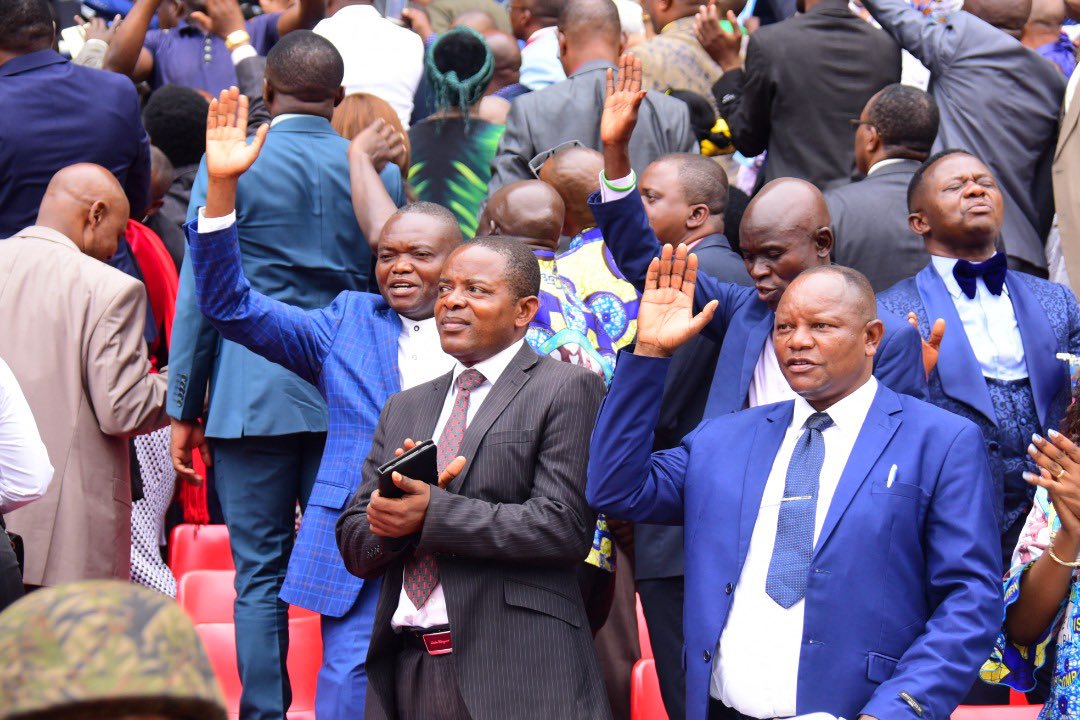
The DR Congo has over 200 spoken languages. Some of these languages spill over into the neighbouring countries like Zambia, Angola, Rwanda, Burundi, Tanzania, Uganda, South Sudan, Cental African Republic and Congo Brazzaville. French (Belgium or Français Belge) is the official lingua franca while besides it, there are 4 national languages. These are :
KIKONGO (also known as Kituba)
Spoken mostly in the South west and used by most government officials in the offices. It is somehow a language of prestige to show off that one is a top government functionary and well read. Kituba speakers often under look lingala speakers as low class.
LINGALA
A business language used in the homes, churches, markets and shops, music industry and the armed forces.
TSHILUBA
Spoken mostly in the South and South east and a few areas of the central, it is the main language spoken alongside Kiswahili especially in the city of Lubumbashi.
SWAHILI
Spoken widely in the east, it is the main mode of communication in the these areas. The armed forces personnel who hail from other none Kiswahili speaking areas are encouraged to learn and speak it alongside Lingala so that whenever duty calls upon them to go to the east, they can ably communicate easily with the locals
My aim is about Lingala. Metaphorically, Lingala is divided into 3 types.

1- LINGALA MAKASI. This is the original Lingala spoken in the countryside along the river Congo in the areas of Mbandaka and Équateur (Equator). It is also known as (Lingala) MAKANZA. It’s strong with rather a heavy donated accent with an elaborate grammar. It is the unadulterated in its pure form. Others call it BANGALA though the Bangala are the people who speak it. Derogatorily, it is referred to as LINGALA YA MBOKA meaning Rural Lingala. An example of Lingala Makasi word is MUSUSU which the Lingala ya Ba Sangó spells and pronounces as MOSUSU. The 2 words are similar in their meaning (Any other) but slightly different in the spelling and pronunciations.
Others words.
Mutu = A person. (Lingala Makasi). Mötu, mötö (Ba Sangó spelling)
Mútú = Head. (Makasi). Mótú, mótó (Ba Sangó).
2- LINGALA YA BA SANGÓ. Lingala of the missionaries.
Closely related to the the MAKASI but rather differentiated by its flat tonal pronunciation of words, this is the Lingala used in the churches. It is the Lingala by which the Bible, the church hymns and the other liturgical works of the churches are done with. It is characterized by the neglect of high and low tones while speaking it.
3- KINDUBILI. This is the type of Lingala spoken in the urban centres. It is set out to artificialize the original Lingala and differs from generation to generation. Each set of generation has its own words and the words keeps on changing with the dynamics of the prevailing circumstances. It has a lot of words borrowed from French, Kiswahili, English, Portuguese and a few Arabic. It is a dialect of prestige used to show off that one is urbanized. Examples of a few sentences in Kindubili.
(à) – Est-ce que oyebi ngai vraiment ? Do you real know me ?
The same sentence can be said in the original makasi form as :
– ya solo yo oyebi ngaie ? In this original form, the suffix -e emphasizes a question though it may appear as an exclamation.
(b) – Tozodommage awa – we are eating now (Kindubili). Tozi koliya sika oyo (Makasi).
– Tozali koliya sikoyo (Ba Sangó)
Etc etc etc etc ……
Latest posts by Joram Jojo (see all)
- The AU Summit Exposed: Why Africa’s Dictators Clap While the Continent Burns - February 17, 2026
- Breaking Free from Tariff Chains: The Economic and Geopolitical Risks of Trump’s Protectionist Policies - April 5, 2025
- African Socialism: Embracing Community, Cooperation, and the Collective Good - January 26, 2025
RELATED PUBLICATIONS:
 EAST AFRICAN POLICE COMMANDERS VISIT THE ETHIOPIAN FEDERAL POLICE
 THE ANGOLA LONG WAR OF INDEPENDENCE
 General Idi Amin Dada and Haile Selassie
 HONORABLE SENATOR FIKIRI ALIMASI DIEUDONNÉ
 DR Congo Mafia Network of Scammers
 CONTINUOUS WORK FOR SAMA LUKONDE KYENGE
 ALLIANCE OF DRIVERS AND OWNERS FOR INTEGRAL DEVELOPMENT IN CONGO